Breville Barista Express vs Pro: Is the Upgrade Worth It?
Choose the controls you will actually use, compare complete purchase costs and work out whether replacing an existing Express is worthwhile.
On this page
- Compare the US models, then the controls
- What the Pro’s screen changes in your routine
- What to check about the grinder
- What the three-second heating claim covers
- Budget for the equipment you will actually use
- Make room to use and maintain it
- Compare replacement cost with the first-purchase premium
- Choose around the controls you will use
If you already own a working Barista Express, I would keep it unless you can name a control on the Barista Pro that would change your routine. A shot clock or temperature menu can be useful; a screen and a higher grind-setting count are weak reasons to replace a machine that meets your needs.
For a first purchase, the Express is the lower-cost route to an integrated grinder and manual milk wand. The Pro suits someone who wants displayed grind time, extraction timing and menu-based adjustments, while accepting the same basket preparation and milk work.
The price difference deserves attention before the feature list. On October 10, 2026, Breville’s US pages displayed $499.95 for the Express and $849.95 for the Pro: a $350 difference. The Express’s underlying structured offer still listed $699.95, so treat the sale as a displayed offer to confirm for your selected variant at checkout. At $699.95, the difference would instead be $150. Check Express · Check Pro.
Compare the US models, then the controls
This guide covers BES870 Barista Express and BES878 Barista Pro. The Express Impress, Touch and Touch Impress have different controls or preparation systems; their features do not transfer to these models.
| Buying detail | Barista Express | Barista Pro |
|---|---|---|
| US offer checked | BES870XL | BES878BSS1BUS1, brushed stainless steel |
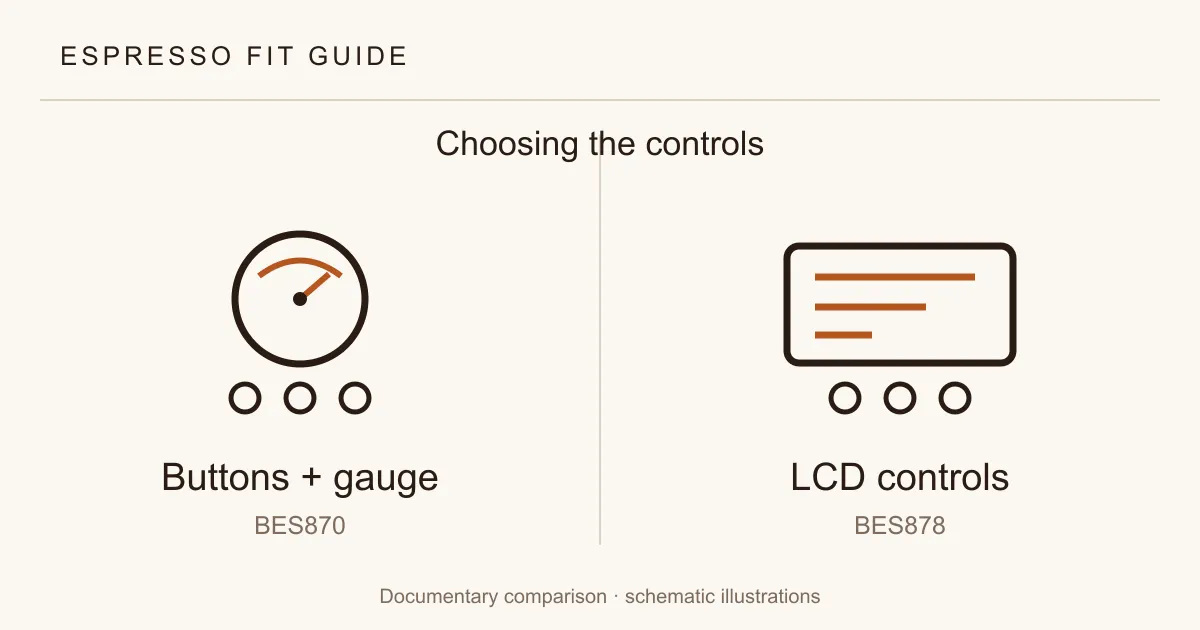
| Main interface | Buttons and pressure gauge | LCD, buttons and menu dial; not a touchscreen |
| Advertised grinder settings | 16 | 30 |
| Advertised heating system | Thermocoil | ThermoJet |
| Tamping and milk | Manual | Manual |
| Displayed machine price, October 10 | $499.95; structured offer disagrees | $849.95; structured offer agrees |
Model details come from the US Express page and US Pro page. Our control comparison uses the linked BES870 USCM–X26 and BES878 USCM–Q26 instructions. Those are document revisions, not verified manufacture dates for every machine on sale.
For a retailer purchase, ask which model and stock generation it supplies. A listing that simply says “Barista” is insufficient for deciding which grinder, controls or accessory pack you will receive.
What the Pro’s screen changes in your routine
The Pro puts grind time, extraction timing and adjustments on its LCD. Regularly using those settings gives you a reason to consider the Pro’s premium. If you prefer the Express’s buttons and gauge, paying for a different interface may not solve a problem you have.
These are the control differences described in the Express instructions, pp.12–17 and Pro instructions, pp.13–17 and 20.
| Task you want to perform | Express control | Pro control | Does the Pro remove your decision? |
|---|---|---|---|
| Change the grinder’s dose | LESS/MORE grind-amount dial | Set the displayed grind time | No: you still check the dose |
| Observe an extraction | Pressure gauge | Shot clock and stage display | No: each supplies different feedback |
| Save a shot setting | PROGRAM and cup buttons | MENU, dial and custom cup setting | No: you decide where to stop |
| Change brewing temperature | Advanced button sequence | SHOT TEMP menu | No: you choose the adjustment |
| Start maintenance | CLEAN/DESCALE indicator and manual procedure | Separate FLUSH/DESCALE alerts and menu | No: cleaning still needs you |
Use that last column to decide whether the premium solves your problem. If you want a clearer display of your chosen settings, the Pro’s interface has a purpose. If you want the machine to decide whether the coffee tastes right, neither interface does that.
Suppose you change beans and want to compare today’s drink with yesterday’s. Write down the grind setting, coffee amount and drink output on either machine. The Pro displays more operating information, but its screen is not a recipe notebook: you still need a separate record if you want to compare those drinks later.
The Pro’s documented shot clock starts during pre-infusion, the initial wetting stage before the main extraction. If you compare times with an external timer, use the same start point. Otherwise, two apparently different times may describe different intervals.
What to check about the grinder
Breville currently advertises Baratza European Precision Burrs on the US Pro page; the Express page describes steel conical burrs. That makes a blanket claim that every Express and Pro has the same grinder unsafe. It also does not prove that a particular retailer’s older Pro stock matches today’s advertisement.
The documented 16-versus-30 setting count tells you how many selectable positions are advertised. It does not tell you how far the burrs move per step, which positions suit your beans or how evenly either machine grinds. Those questions need evidence beyond the setting count.
Avoid buying the Pro solely because “30 is almost twice 16.” A more useful question is whether you want its way of setting grind time, and whether the seller can confirm the advertised hardware for the unit supplied. If your existing Express already supports a recipe you enjoy, the count alone is a weak replacement reason. Current Pro grinder description.
Neither model’s timed dispensing should be treated as an integrated weighing system. Time and coffee weight are different quantities. If you want a recipe based on weight, allow for a suitable separate scale and check the amount delivered rather than assuming a saved grind time guarantees it.
What the three-second heating claim covers
Breville says the Pro’s ThermoJet system reaches extraction temperature in three seconds. That describes the heating system reaching extraction temperature, rather than the time to a finished drink. Grinding, basket preparation, extraction and milk handling still need to happen. The Express uses a different heating system; this startup specification does not tell you the difference between their complete morning routines. Breville’s heating description.
If you are paying for a quicker morning, consider the routine you actually need: one espresso, two milk drinks or several drinks with different beans. A startup claim alone cannot settle those comparisons. For several drinks in succession, look for a comparison using that drink sequence and the exact machine generations you are considering.
Both models require manual milk texturing. You position the jug and operate the wand, then clean it. The Pro is not the automatic-milk choice just because it has a screen. Both also provide hot water; a dedicated outlet does not mean an automatically assembled Americano.
If your main complaint is tamping or holding the milk jug, buying the Pro does not remove those jobs. For dose feedback and a tamp lever, compare the Express with the Express Impress before paying for the Pro’s screen. Milk remains manual in that comparison too.
Budget for the equipment you will actually use
Both machines include an integrated grinder. You do not need to add a separate grinder to compare their basic fresh-bean purchase costs.
Breville’s current accessory lists and manuals describe a 54 mm portafilter, single- and dual-wall baskets, removable tamper, milk jug, dosing funnel, Razor trimming tool and cleaning/filter supplies. Check the seller’s exact accessory pack before buying duplicates. The Pro manual’s components and accessories, pp.7–8, identify its portafilter and removable tamper. Shared nominal diameter does not certify every third-party basket or portafilter as compatible. Express accessory list · Pro accessory list.
| Budget line, USD | Express | Pro |
|---|---|---|
| Displayed machine-only subtotal, October 10 | $499.95 | $849.95 |
| Separate grinder needed for this comparison | $0 | $0 |
| Missing scale, cups or other equipment | Add your verified costs | Add your verified costs |
| Tax, delivery and consumables | Add applicable charges | Add applicable charges |
The first row is not a complete station total. Beans, milk, suitable water, replenishment filters and cleaning products also remain ownership costs. A retailer’s basket and a manufacturer’s bundle can have different contents and charges.
Use this worksheet before checkout:
Station total = confirmed machine price + equipment you lack + tax + delivery + initial consumables.
Count items you already own as zero additional purchase cost. Do not count an included jug or tamper again. If both choices need the same extras, those extras do not change the machine-price difference.
For an illustration only, an identical $50 allowance for missing equipment would make the displayed equipment subtotals $549.95 and $899.95. That is budget arithmetic, not a sourced $50 kit or complete installed price. Replace it with real items before treating either total as your spending plan.
If the Express sale does not apply, repeat the comparison with the actual checkout prices. At the page’s $699.95 reference price, its illustrative subtotal becomes $749.95 and the Pro premium falls to $150. The recommendation should follow that changed purchase condition.
Make room to use and maintain it
Do not buy from an appliance height alone. You need access to the rear tank, hopper, portafilter and milk wand, as well as room to remove the drip tray. The advertised dimensions do not settle tank-lift space or cup-plus-scale clearance. Confirm the dimensional axes and operating access with the seller or a measured unit before assuming cabinet fit.
The Pro’s maintenance menus make the requested cycle more explicit; they do not eliminate maintenance. Follow the instructions supplied with your unit, including the distinction between cleaning and descaling. Avoid treating a comparison table as a substitute for the full cleaning procedure.
Compare replacement cost with the first-purchase premium
A $350 gap between two new machines is not the replacement cost for an Express you already own. For that decision, use:
Upgrade outlay = confirmed Pro purchase + replacement-specific costs − actual proceeds from selling the Express.
If you keep the old machine or do not sell it, there are no sale proceeds to subtract. Compare that outlay with the specific control you want to gain. If the problem is a fault, get a repair quote too; the new-machine premium does not answer whether repair is worthwhile.
I would keep a working Express when the current recipe and preparation routine suit you. If a display or temperature menu would solve a recurring difficulty, price that change using your actual purchase and resale figures. Neither a screen nor the advertised grinder-setting count, by itself, establishes a taste or reliability improvement.
Choose around the controls you will use
Buy the Express if you accept manual preparation and milk, prefer its controls and want the lower confirmed purchase price. At the displayed $350 gap, have a specific use for the Pro’s features before spending more.
Buy the Pro if you want its visible timing and menu-based adjustments, accept the same manual responsibilities and have confirmed the supplied grinder generation. A smaller checkout gap may make those features more attractive, but it still does not establish better taste.
Buy neither if automatic milk or assisted tamping is essential, access has not been checked, or you already own a suitable grinder and want to compare separate-machine options. Write down that requirement first. It can change the shortlist more than either model’s advertised feature count.
Before ordering, write down the Pro controls you expect to use and compare the confirmed totals. If the extra controls would sit unused, the Express leaves more of the budget for the equipment and supplies you still need.