Breville Barista Express vs Express Impress: is assisted preparation worth it?
Choose between manual puck preparation and assisted dosing and tamping, with the price differences and remaining work made clear.
On this page
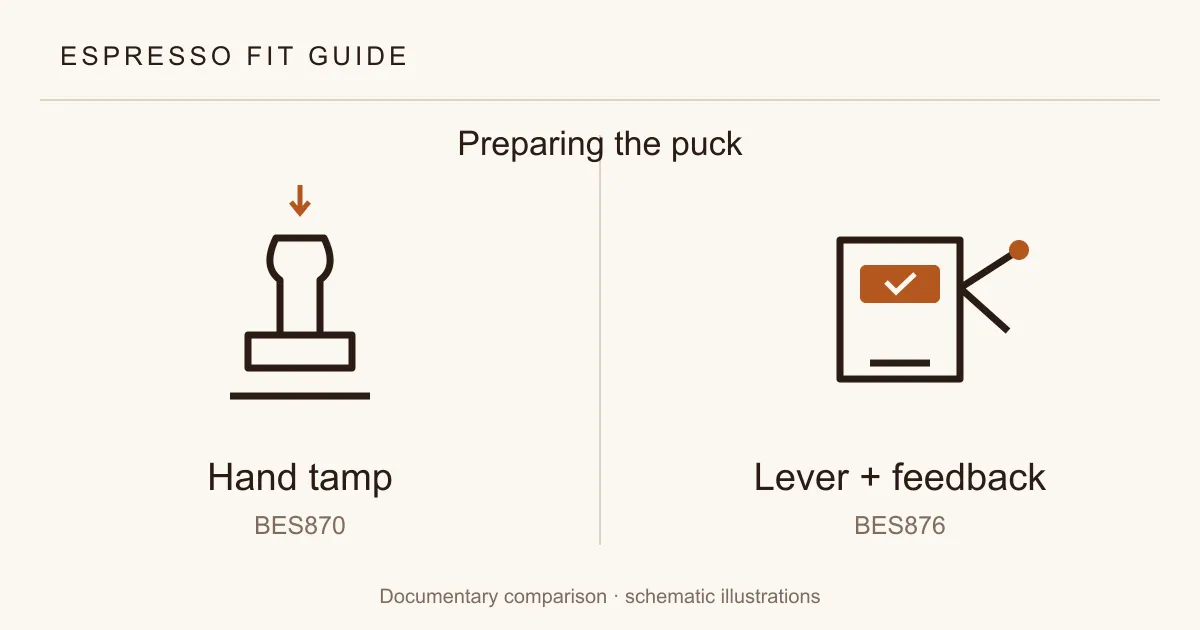
The Barista Express Impress makes the most sense when judging the coffee dose and tamping by hand are the steps you want help with. Its dose indicator and tamp lever guide basket preparation. If you are comfortable with a handheld tamper, the original Barista Express gives you a lower-cost route to an integrated grinder and manual milk wand.
I would pay for the Impress’s assistance only if it addresses a task I want to change. You still move the portafilter, start the shot and steam the milk yourself; the premium buys guidance during preparation, not a finished drink.
At our October 10, 2026 check, Breville’s US pages displayed $499.95 for the Express and $649.95 for the Express Impress. Their machine-readable offers showed higher amounts. Treat the $150 displayed difference as a shopping observation, rather than a verified checkout quote.
Start with the right Express
Here, Express Impress means BES876, not the touchscreen Touch Impress. The original Express is BES870. Our price links select brushed stainless steel: BES870XL and BES876BSS1BNA1 respectively. A different color, country or retailer bundle needs its own check.
| Buying detail | Barista Express, BES870 | Barista Express Impress, BES876 |
|---|---|---|
| Integrated grinder | Yes; 16 advertised settings | Yes; 25 advertised settings |
| Preparation assistance | User adjusts grind amount and uses a removable tamper | Dose-level feedback and user-operated tamp lever |
| Milk | Manual steam wand | Manual steam wand |
| Portafilter | 54 mm | 54 mm |
| Extraction feedback | Pressure gauge | Pressure gauge |
| Relevant US manual | USCM–X26 | USCM–F26 |
The setting counts and shared functions come from Breville’s US Express page and US Express Impress page. They identify controls, rather than a measured difference in grinding performance.
For this purchase, the tamp-and-feedback arrangement is a more useful distinction than the setting count. More positions on a dial do not tell you which grinder suits your beans or produces a drink you prefer.
Follow the basket from grinder to brew head
The matrix below follows the Express X26 manual, printed pages 12–14, and the Express Impress F26 manual, pages 14–18. It compares actions, not measured elapsed time.
| Step | Express | Express Impress |
|---|---|---|
| 1. Set up the dose | Choose basket size and grind controls | Choose basket size and grind setting |
| 2. Grind | Activate grinding through the portafilter in its cradle | Start grinding with the Dose button |
| 3. Tamp | Remove portafilter and use the handheld tamper | Push the lever, then return it to its home position |
| 4. Check preparation | Judge tamped level; trim excess if needed | Read dose-level feedback; add coffee and retamp for underdose, or remove and Razor-trim an overdose |
| 5. Brew | Remove dosing funnel before transferring to the group head | Transfer prepared portafilter from cradle to group head |
The Express asks you to judge the prepared basket; the Impress gives you an indicator to respond to. That is the practical difference to weigh against the price.
Consider a hypothetical first-time buyer who wants a prompt after tamping rather than judging the coffee level unaided. The Impress fits that preference. Someone who is happy checking the basket and correcting it by hand has less reason to pay for that particular feature.
The indicator still asks you to make corrections
In automatic dosing mode, the F26 manual describes feedback after tamping and adjustments to a later grind cycle. An underdose asks you to press Dose again and retamp; an overdose can require removing the portafilter and trimming with the supplied Razor tool. The indicator guides corrections rather than removing them. See F26, pages 15–17.
Dose-level feedback also differs from a gram reading. If you want to weigh the coffee or the drink, budget for a suitable separate scale. A satisfactory indicator level does not decide whether you like the espresso: the coffee and your preparation choices still matter.
For a household sharing the machine, ask a practical question: is everyone prepared to use the feedback and correct the basket when necessary? If the answer is no, paying for a guided step may still leave you with the wrong kind of machine.
Milk and cleanup remain part of the purchase
Both US product pages specify manual milk texturing. If your main frustration is holding a milk jug and managing steam, the Express Impress does not address that buying requirement. Keep automatic milk preparation as a separate filter when considering other machines.
You still position the jug, operate the steam control and manage the milk yourself. Afterwards, wand wiping and purging remain manual care tasks. Follow the applicable Express care instructions or Impress care instructions; assisted tamping does not perform them.
The Impress also has a tamp-system cleaning procedure, in addition to ordinary machine care: F26, page 27. Assistance is therefore something to maintain, not a reason to disregard cleanup.
If “I want a latte without managing the milk” describes your goal, look beyond this pair. If your concern is hand strength or mobility, ask to try the lever, portafilter and jug handling before ordering. The assisted mechanism alone does not establish suitability for a particular physical limitation.
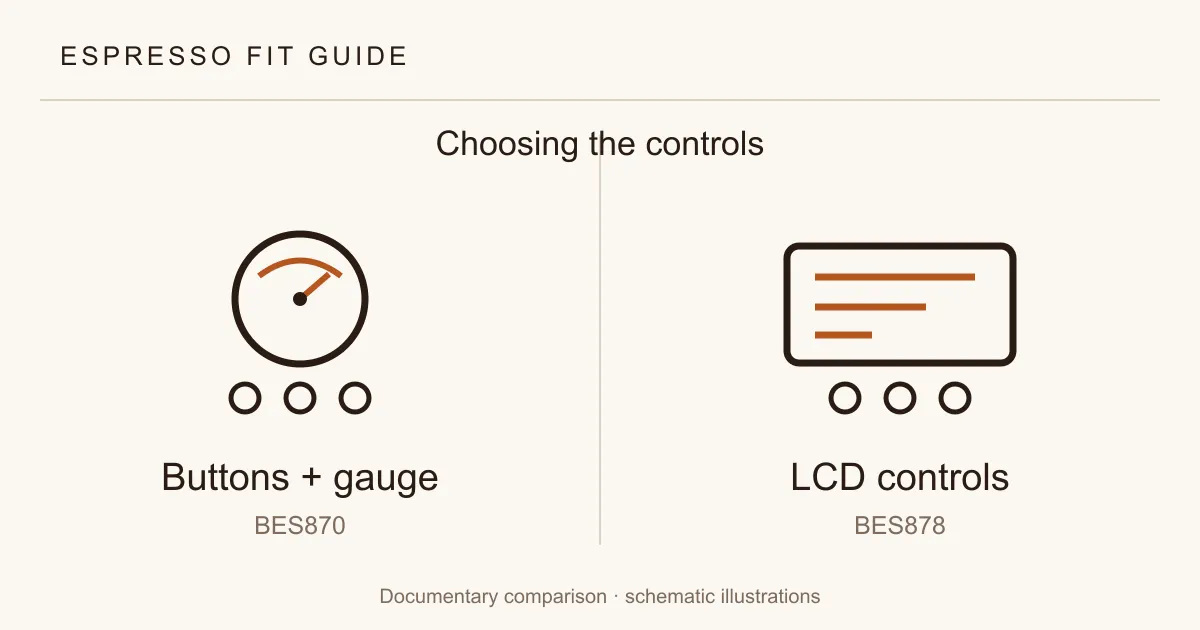
If you want a screen and visible timing instead of help tamping, see the Barista Express versus Pro comparison. The Pro addresses a different buying decision.
Price the machine first, then the station
These are US-dollar observations on October 10, 2026, selecting the stainless variants above. Both pages displayed an Add to cart action; final charges, delivery and stock allocation need confirmation at checkout.
| Price observation | Express | Express Impress | Impress premium |
|---|---|---|---|
| Displayed storefront amount | $499.95 | $649.95 | $150.00 |
| Exact-SKU machine-readable offer | $699.95 | $799.95 | $100.00 |
Sources: Breville Express and Breville Express Impress. Because the displayed and structured amounts disagree, compare confirmed checkout quotes for the same market, color and included equipment before deciding.
Both machines contain a grinder, so adding a separate grinder automatically would overstate the equipment required for this comparison. Breville lists a portafilter, single- and dual-wall baskets, milk jug, water-filter hardware and cleaning items for each. The Express lists a removable tamper and dosing funnel; the Impress uses its assisted tamping arrangement. Confirm the seller’s actual box contents, especially with refurbished units or bundles.
That leaves three different budget questions:
| Budget level | What the figure covers | What still needs a price |
|---|---|---|
| Machine with integrated grinder | The selected machine offer | Final checkout charges and confirmed contents |
| Chosen preparation equipment | Machine plus any equipment you actually decide to add | Suitable scale, cups or other selected items |
| Complete usable station | The above plus supplies and any necessary setup | Coffee, appropriate water provision and any missing essentials |
A complete-station total depends on the additions you actually need. Taxes, any shipping charges, replacement filters, cleaning supplies and future maintenance are outside the displayed machine amounts. Count equipment you already own as zero additional purchase cost.
For comparing your own quotes, use:
First-purchase difference = confirmed Impress total − confirmed Express total.
Include the same required extras on both sides. If you would buy a scale for either machine, it increases both budgets without necessarily changing their difference. If one seller’s package includes an item you genuinely need and the other’s does not, add its actual replacement cost only to the latter.
Leave room to use the portafilter, reach the tank and work with the jug. Confirm operating access and cabinet clearance for your location; an appliance’s outside dimensions alone do not establish usable fit.
Already own a working Express? Compare replacement cost
The $150 displayed premium is relevant to a buyer choosing between two new machines. It is not the cost of upgrading a machine you already own.
For an existing owner, the useful calculation is:
Upgrade outlay = confirmed Impress purchase + replacement-specific costs − actual proceeds from the old machine.
For a hypothetical example, buying at $649.95 and receiving $200 from selling the old machine leaves $449.95 before other costs. The $200 is an illustrative input, not a resale estimate. Without a sale, budget for the full purchase.
Keep the Express if its preparation routine already suits you. Replacing it makes more sense when basket preparation is a persistent frustration and the Impress’s specific controls address it. If the real problem is a fault, get a repair quote before comparing repair with replacement.
Name the step you want to change
Choose the Express when manual basket preparation is acceptable and its confirmed total leaves room for the equipment and supplies you need.
Consider the Express Impress when dose feedback and a tamp lever address your specific hesitation—and you accept the remaining corrections, milk work and cleanup. Recheck the actual premium before buying.
Choose neither if automatic milk or minimal portafilter handling is essential, or physical suitability is still uncertain.
Before ordering, confirm the two checkout totals and included items. Then name the preparation step the Impress would change for you. If the answer is only “it’s the newer one,” keep the lower-cost Express on your shortlist.